What Real Estate Listings Don’t Tell You About the Neighborhood
 Oleg Tikhonov
Quick Answer
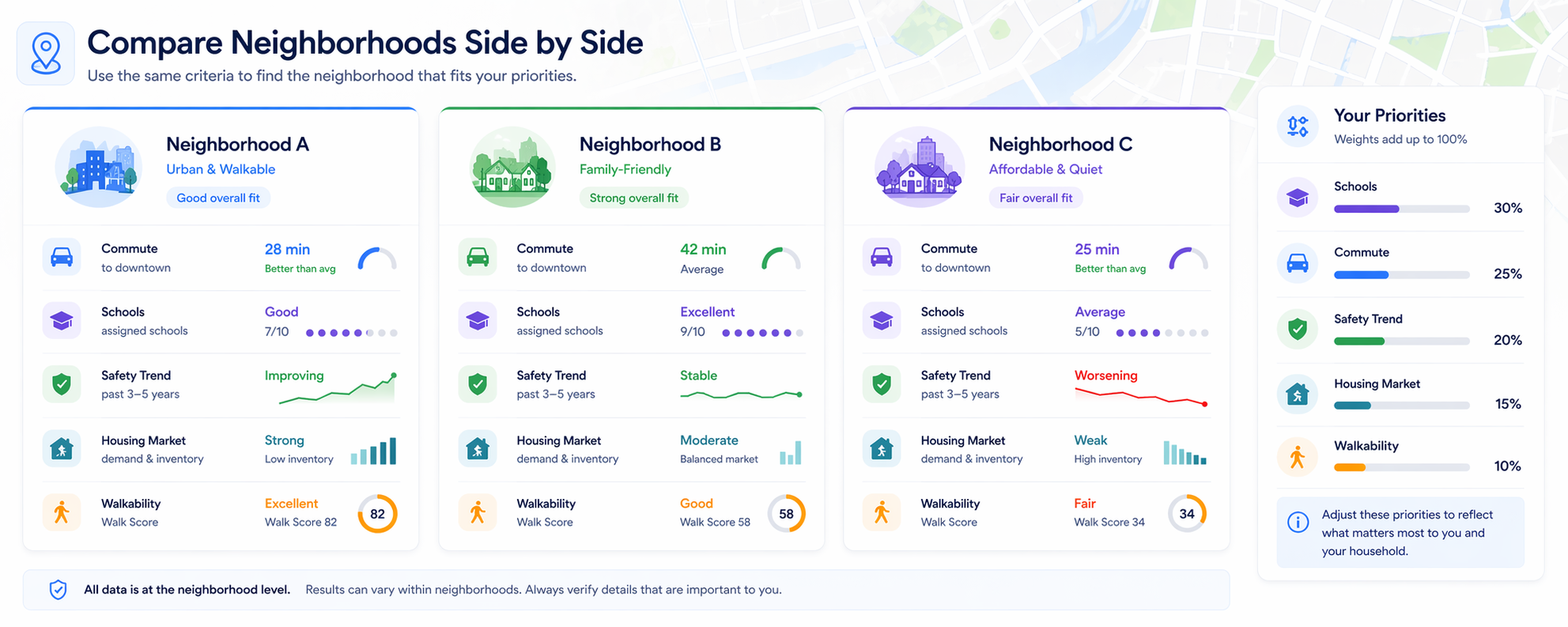
Real estate listings tell you about the property: size, price, bedrooms, lot, photos, visible features, and basic transaction details. They usually do not explain the neighborhood context around the property — including safety trends, school boundaries, commute reality, flood exposure, local direction of change, and long-term livability factors.
A listing helps you evaluate the house. Neighborhood data helps you evaluate the life around the house.
Listing Data vs. Neighborhood Data
A listing answers property questions. Neighborhood research answers context questions.
| Listing data usually shows | Neighborhood data helps answer |
|---|---|
| How many bedrooms does the home have? | What kind of daily life does the area support? |
| What is the asking price? | How does the area compare with nearby neighborhoods? |
| How large is the lot? | Is the neighborhood changing, stable, or under pressure? |
| What renovations were done? | Are there hidden risks that affect insurance, resale, or quality of life? |
| How far is it from major roads? | What does the real commute look like at the time you will travel? |
| What school district is mentioned? | Which specific attendance-zone schools serve the address? |
| What does the property look like in photos? | What is the context around the property: boundaries, trends, risks, and trade-offs? |
The problem is not that listing data is useless. It is that listing data is incomplete. It shows the asset, not the environment around the asset.
Why Listing Photos Can Make the Decision Feel More Complete Than It Is
A listing is designed to describe a property.
That sounds obvious, but it matters. Square footage, bedroom count, lot size, year built, photos, renovations, HOA fees, and listing price are all property-level details.
They help you decide whether a house is worth viewing.
They do not tell you whether the surrounding neighborhood fits your daily life, financial risk tolerance, commute, school needs, insurance exposure, or long-term plans.
That gap is where many homebuyers make expensive mistakes. They fall in love with the house first, then discover the neighborhood context later.
A beautiful kitchen can distract from a difficult commute. A renovated bathroom can distract from flood exposure. A lower price can distract from weak local demand. A quiet-looking street in listing photos can distract from the fact that you have only seen the area at one moment in time.
The listing is one layer of the decision. It should not be the whole decision.
1. Safety Context, Not Just Neighborhood Reputation
A listing will not tell you much about safety context. At most, you may see vague marketing language such as “quiet street” or “desirable area.”
That is not the same as data.
The important question is not whether an area has a reputation for being “good” or “bad.” The better question is whether reported incidents have been increasing, decreasing, or staying relatively stable over time.
A single number can mislead. A multi-year trend gives more context.
What the listing shows:
- The address
- Photos of the home and street
- Sometimes broad location language
What it does not show:
- Multi-year reported incident trends
- How the neighborhood compares with nearby areas
- Whether conditions are changing over time
- Data limitations or source methodology
This does not mean a listing is hiding something. It means safety context is neighborhood-level information, not property-description information.
2. School Boundaries, Not Just District Names
A listing may mention a school district. That is not enough.
The practical question is which specific schools the address is assigned to today. District-level averages can hide major variation between attendance zones.
Two homes in the same district may be assigned to different elementary, middle, or high schools. They may also be affected differently by boundary changes, overcrowding, or rezoning discussions.
What the listing shows:
- Sometimes the school district
- Sometimes nearby schools
- Sometimes school names pulled from a data feed
What it does not reliably explain:
- The exact attendance zone
- Whether school boundaries recently changed
- Whether boundary changes are being discussed
- Whether the listed school information is current
- How school access may affect future buyer demand
School access can matter even for buyers without children because many future buyers do care about it. But the point is not to label one neighborhood as better than another. The point is to understand the specific school context attached to the address.
3. Commute Reality, Not Distance to Downtown
Listings often mention proximity: minutes to downtown, near major highways, close to transit, convenient location.
But proximity is not the same as real commute.
A home can be physically close to work and still produce a frustrating daily commute because of traffic patterns, school drop-off zones, bridge crossings, limited transit frequency, or bottlenecks at specific times of day.
What the listing shows:
- Distance to major roads
- Distance to downtown or transit
- Sometimes a generic map view
What it does not show:
- Tuesday morning commute time
- Evening return commute
- Transit frequency and wait time
- Walking time to stops
- Whether the route is reliable or highly variable
- How the commute changes in bad weather or peak season
The difference between a 25-minute off-peak estimate and a 50-minute weekday commute is not a small detail. It changes how the neighborhood feels every week.
4. Flood and Insurance Exposure, Not Just Property Photos
A listing photo can show a dry, sunny property. It will not necessarily make flood exposure obvious.
Flood risk is often property-specific and location-specific. Disclosure rules vary by state, transaction context, and property history. That means buyers should not rely on the listing alone to understand flood or environmental exposure.
What the listing shows:
- Property photos
- Lot description
- Sometimes waterfront or canal proximity
- Sometimes seller disclosures, depending on the market and process
What it may not clearly show:
- FEMA flood zone designation
- Whether flood insurance may be required by a lender
- Whether flood maps are current
- Elevation or drainage context
- Nearby environmental sites
- How risk may affect insurance cost or future buyer demand
Flood risk is not only about whether the home has flooded before. It can affect financing, insurance, resale friction, and the number of buyers willing to consider the property later.
5. Local Direction of Change, Not Just Current Listing Price
A listing shows the current asking price. It may show price history for that property. It does not explain the direction of the surrounding area.
A neighborhood can look stable in listing photos while the underlying signals are changing. Employment, household income, building permits, business activity, vacancy, and housing inventory all help explain whether an area is gaining momentum, staying flat, or facing pressure.
What the listing shows:
- Asking price
- Property tax estimate
- Sometimes price history
- Sometimes nearby comparable sales
What it does not show clearly:
- Whether local income is rising or flat
- Whether households are moving in or out
- Whether businesses and employers are expanding or contracting nearby
- Whether new construction or renovation activity is concentrated in the area
- Whether inventory and days on market are changing compared with nearby neighborhoods
This matters because a home is not only a structure. It is part of a local market. The surrounding area can influence demand, services, resale, and the buyer pool years later.
Why Listings Leave Out Neighborhood Context
Most listings are not designed to be complete neighborhood research tools.
They are designed to market and describe a property.
There are several reasons neighborhood context is usually missing:
- Listings are property-first. The standard format is built around the home: price, size, photos, features, and transaction details.
- Neighborhood data comes from different sources. Safety trends, schools, Census, flood maps, commute, and market data all live in separate systems.
- Some topics are sensitive. Safety, demographics, schools, and neighborhood reputation can create legal, ethical, or fair-housing concerns if handled carelessly.
- Agents and sellers have different incentives. Their job is to market the property, not necessarily to build a neutral research file for every buyer.
- Context requires comparison. A number means little unless you compare it with nearby areas, historical trends, or your own priorities.
That is why buyers need a separate neighborhood research layer before they become emotionally attached to a listing.
What to Do Before You Trust a Listing Too Much
Before you schedule multiple tours or make an offer, separate the property from the neighborhood.
Ask:
- Does this home still make sense if the commute is worse than expected?
- Does the address match the school attendance zone you assumed?
- Is the flood or insurance exposure acceptable?
- Does the neighborhood trend support the price you are considering?
- Would this area still fit your life if the house photos were less attractive?
If the answer depends entirely on the house being perfect, slow down. You may be evaluating the listing more than the neighborhood.
A good listing can make a home attractive. It cannot tell you whether the area fits your life.
Listings Show the House. Research Shows the Context.
The listing is only one layer of the decision.
It helps you understand the property. It does not fully explain the neighborhood around it, the daily life it creates, or the risks and trade-offs that may matter after closing.
That is why neighborhood research should happen before you fall in love with a house.
Settilo helps buyers look beyond the listing by bringing neighborhood-level public data into a more structured view. The goal is not to replace listings, agents, inspections, or legal review. The goal is to help buyers understand the area before the decision becomes emotional.
The listing shows what you are buying. Neighborhood data shows what you are buying into.